|
The Board acknowledges the need for and continued maintenance of the highest standards of corporate governance practice and ethical conduct by all Directors and employees of Michael Hill International Limited and its subsidiaries.
The Board endorses the overall principles embodied in the New Zealand Institute of Directors'"Code of Proper Practice for Directors".
The Board believes that its corporate governance policies and procedures do not materially differ from those detailed in the NZX Best Practice Code. There have been no changes made to the Corporate Governance practices since last year.
THE BOARD IS ACCOUNTABLE FOR THE PERFORMANCE OF THE GROUP
The Board is responsible to shareholders for charting the direction of the Group by participation in the setting of objectives, strategy and key policy areas. It is then responsible for monitoring management's running of the business to ensure implementation is in accordance with the agreed framework. The Board delegates the conduct of the day-to-day affairs of the Company to the Chief Executive Officer within this framework.
The workings of the Board and its code of conduct are governed by the Company's constitution and a Board Operations Manual, committed to by all Directors. This manual sets out all the functions and operating procedures of the Board, including charters for each subcommittee. The Board Operations Manual also clearly sets out those matters that only the Board can make decisions on. These include dividend payments, solvency certificates, raising new capital, major borrowings, approval of the annual accounts, provision of information to shareholders, major capital expenditure, and acquisitions.
Each year, the company produces a five year plan and an operating budget which are both reviewed and approved by the Board. Financial statements are prepared monthly and reviewed by the Board progressively through the year to monitor management's performance against the budget and five year plan.
BOARD MEMBERSHIP
The Constitution currently sets the size of the Board at a minimum of three and a maximum of eight and at least two Directors must be resident in New Zealand. The Board currently comprises seven Directors, comprising an Executive Chairman, a Chief Executive Offi cer, and five non-executive Directors. The Board met on five occasions in the fi nancial year ended 30 June 2007. Profi les of the current Directors appear on page 21 of the annual report. Under the Companys constitution, and the NZX Listing rules, one third of all Directors must retire every year, but can be re-elected at an annual meeting if eligible. Newly appointed Directors must seek re-election at the fi rst annual meeting of shareholders following their appointment.
The Company has no requirement for Directors to hold shares in the company but actively encourages them to do so and all current Directors have a substantial holding in the company.
INDEPENDENT DIRECTORS
Under the NZX Listing rules, the Company is obliged to have at least two independent directors.
An independent Director has been defined in the NZX rules as a "Director who is not an executive of the Issuer and who has no Disqualifying Relationship."
A Disqualifying Relationship means any direct or indirect interest or relationship that could reasonably influence, in a material way, the Director's decisions in relation to the Issuer.
The Company has determined that Gary Gwynne and Murray Doyle are independent Directors under the NZX rules.
DIRECTORS' SHAREHOLDINGS - See Page 57 of the Annual Report
DIRECTORS' MEETINGS
The number of meetings held throughout the past year is detailed on the below. The agenda for meetings is prepared by the Company Secretary in conjunction with the Chairman and the Chief Executive Officer. Any member of the Board may request the addition of an item to the agenda. Board papers are circulated to Directors a week in advance of meetings.
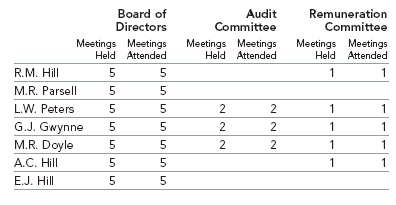
The table below sets out the Board and sub-committee meetings attended by Directors during the course of the Financial Year.
THE WORK OF DIRECTORS
Non-executive directors normally spend around 22 days per year on board and sub-committee meetings. The length of meetings varies between one to two days. Board meetings are held in different locations in Australia and New Zealand.
BOARD REVIEW
During the course of the last financial year, the Chairman reviewed the performance of the Directors and the workings of the Board. There were no changes made to any of the Boards processes as a result of this review.
CHIEF EXECUTIVE OFFICE PERFORMANCE REVIEW
The Board regularly reviews the performance of the Chief Executive Officer.This evaluation is based on the performance of the business, the accomplishment of strategic and operational objectives and other non quantitative measures.
BOARD COMMITTEES
The Board has established a number of sub-committees to guide and assist the Board with overseeing certain aspects of corporate governance - the audit process, determination of compensation issues and the structure of the Board itself. Each sub-committee is empowered to seek any information it requires from employees in pursuing its duties and to obtain independent legal or other professional advice. The provision of such advice, if required, would be arranged in consultation with the Chairman. In circumstances where a Director was to obtain separate advice from that obtained on behalf of the Group, that advice would normally be provided to all Directors.
AUDIT SUB-COMMITTEE
The Audit sub-committee, which is chaired by Murray Doyle and consists of Messrs Doyle , Peters and Gwynne , met twice during the year. The function of the Audit sub-committee is to assist the Board in carrying out its responsibilities under the Companies Act 1993 and the Financial Reporting Act 1993, regarding management's accountancy practices, policies and controls relative to the Group's financial position and to review and make appropriate inquiry into the audits of the Group's financial statements by both internal and external auditors. This responsibility includes advising on the appointment of the external auditor and reviewing the scope and quality of the audit. The audit sub-committee has the responsibility of monitoring the Group's Risk Management practices and procedures to ensure that policies and processes exist to effectively identify, manage and monitor principle business risks. The Group's auditors, both internal and external, along with other relevant senior executives, attend all meetings and may discuss any matters in connection to audits, the Group's risk and control environment or any other matters relating to the Group's financial and non-financial affairs.
This committee also approves any non audit work carried out by the Company's auditors, and ensures that the lead partner in the audit firm is rotated every five years. The committee will also approve all major accounting policy changes.
At least once a year, the Chairman and non-executive Directors on this Committee meet with the external auditors privately without the presence of Company executives.
REMUNERATION SUB-COMMITTEE
This sub-committee, chaired by Wayne Peters, comprises all Directors except Mike Parsell. The function of the Remuneration sub-committee is to determine the Chief Executive's and Senior Management's remuneration. This role also includes responsibility for share option schemes, incentive performance packages, and fringe benefit policies. The sub-committee also advises on proposals for significant company wide remuneration policies and programs. In carrying out this role, the sub-committee operates independently of Senior Management of the Company, and obtains independent advice on the appropriateness of the remuneration packages. The committee met on two occasions during the year.
This sub-committee also has the responsibility to review the performance of the Chief Executive Officer on an annual basis.
The committee has continued to structure Senior Management bonuses around a return on capital employed basis, to emphasise efficient use of capital.
NOMINATIONS SUB-COMMITTEE
This sub-committee, chaired by Michael Hill, consists of the non-executive Directors and Michael Hill. The function of the subcommittee is to make recommendations to the Board regarding the most appropriate Board structure. It also advises on the appointment of additional Directors. Board membership is reviewed periodically to ensure the Board has an appropriate mix of qualifications, skills and experience. External advisors may be used to assist this process.
Any person who is to be considered as a Director of the Company must attend three Board meetings in the capacity of a Consultant before being eligible for appointment as a Director.
Emma Hill was appointed a Director by the Board in February 2007.
SHARE TRADING BY DIRECTORS
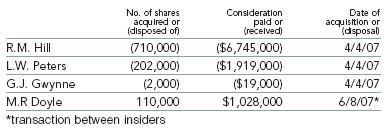
The Directors named below have disclosed to the Board under Section 148 of the Companies Act 1993, particulars of the following acquisitions or dispositions of relevant interests in the ordinary shares of the company during the year. The relevant interest acquired or disposed of includes beneficial ownership.
NON-EXECUTIVE DIRECTORS' FEES
Fees for non-executive directors are based on the nature of their work and their responsibilities. The Company is now a truly global company with 74% of the Groups stores in Australia and Canada. Shareholders at the Annual Meeting in November 2004 approved a maximum amount of $250,000 to be paid to Directors. Each NZ resident Director is currently paid $60,000 per annum and our Australian resident Director A$60,000 per annum. No equity incentives are offered to non-executive Directors. A resolution is being put to the Annual meeting on 8th November 2007 to increase the aggregate amount to be paid to non executive directors to NZ$395,000.
Under the Companys new constitution adopted in November 2004, shareholders will now be required to approve all retirement benefits for directors other than for directors who were in office on or before 1 May 2004 and who have continued to hold office. It is not the intention to pay any such retirement allowances.
SHARE PURCHASE SCHEME
The Company has a Share Purchase Scheme for Management in operation. The scheme was designed to encourage Store Managers, Regional Managers and other senior employees of the Company to purchase shares in the Company. In order to provide a pool of shares for eligible employees to purchase, the Company from time to time will buy Michael Hill International shares on the New Zealand Stock Exchange.
The rules of the scheme provide for the Company to on sell shares to purchasing employees at a 10% discount to the weighted average price for the ordinary shares during the 10 working day period ending 2 working days immediately prior to the date on which the Company offers shares to the employees. The discount is deemed to be financial assistance under the Companies Act 1993.
The Trustees of the scheme hold the shares for a restrictive period of one year, which is to promote the concept of encouraging long-term investing in the Company. The company holds a further 75,654 shares which are held as Treasury Stock and will be used for the next issue of shares under the scheme in September 2007.
SHARE OPTIONS
There were no new options issued to staff during the year. There are 200,000 options outstanding to employees as at 30 June 2007. Further information on options outstanding to employees are included in note 25 to the Financial Statements on page 57 of the annual report.
COMMUNICATION WITH SHAREHOLDERS
Michael Hill International places high importance on communication with shareholders. A half year and annual report is published each year and posted on the MHI website.
Announcements to the New Zealand Stock Exchange and the media are also posted on the website as are copies of presentations for Analysts which are done once a year in conjunction with the release of the annual results for the year.
The Company Secretary takes primary responsibility for communications with the New Zealand Stock Exchange in relation to listing rule obligations and disclosure obligations. Shareholders may raise matters for discussion at Annual meetings and have the ultimate control in corporate governance by voting Directors on or off the Board.
CONTINUOUS DISCLOSURE POLICY
With the introduction of the new NZX continuous disclosure rules from December 2002, the Board has adopted the following procedure:
- At each Board meeting, a standard agenda item is now considered
-"Does the Company have anything to disclose?" The Board considers the information in its possession and decides appropriately whether any information needs to be disclosed to the market.
- Between Board meetings, management will bring to the attention of the Directors any information they believe should be disclosed to the market for their consideration.
- The Company now discloses revenue figures for the group to the market for the first and third quarters in advance of the earnings announcement. For the second and fourth quarters, sales figures are released with the earnings results. In the all important Christmas trading period, an announcement on sales alone for the second quarter without reference to profitability could result in misinterpretation by the market.The Board considers it sensible to combine the sales and earnings release for the second and fourth quarters in order that the market understands how sales translated into earnings.
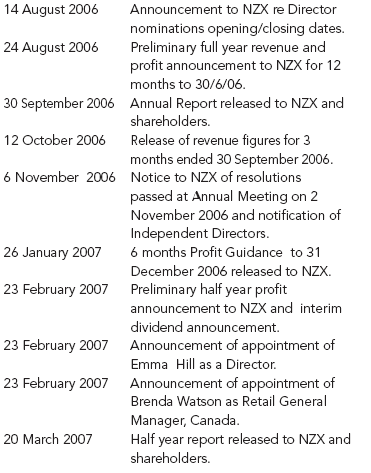
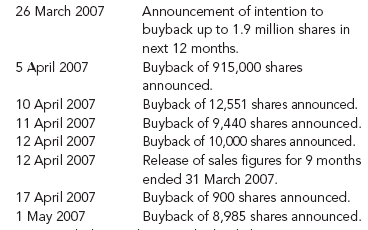
- In the 12 months ended June 2007, the Company has made the following disclosures to NZX under the continuous disclosure rules:
The Company believes it has complied with the NZX Continuous disclosure rules.
EXTERNAL AUDIT INDEPENDENCE POLICY
The Group has adopted the following policy to ensure that audit independence is maintained, both in fact and appearance, such that Michael Hill International's external financial reporting is viewed as being highly reliable and credible.
The policy covers the following areas:
- Provision of non audit services by the external auditors
- Fees and billings by the auditors
- Hiring of staff from the audit firm
PROVISION OF NON AUDIT SERVICES BY THE EXTERNAL AUDITING FIRM
Our external auditing firm should not undertake any role not permitted under IFAC (International Federation of Accountants) regulations regarding independence of auditors. Under the IFAC guidelines, the table below sets out the type of non audit work that Michael Hill International will allow its external auditing firm to perform.
BOOKKEEPING
Prohibited, other than in emergency situations. Managerial decision making prohibited.
VALUATIONS
Prohibited.
TAX SERVICES
Permitted, as not seen to threaten independence
PROVISION OF IT SYSTEMS
Design and implementation of financial IT systems prohibited.
STAFF SECONDMENT FROM AUDITORS
These are permitted with safeguards. No management decision making. Signing agreements or discretionary authority to commit MHI is not allowed.
LITIGATION SUPPORT SERVICES
Permitted with safeguards.
LEGAL SERVICES
Permitted where immaterial to the financial statements.
EXECUTIVE SEARCH AND SELECTION
Permitted with safeguards. Making selection for MHI prohibited.
CORPORATE FINANCE Permitted with safeguards. Promoting, dealing in or underwriting MHI Securities prohibited.
The safeguards put in place will be specific to the circumstances of each case. The general rule to be applied is whether an independent third party would consider the safeguards reasonable.
FEES AND BILLINGS
All audit and non audit fees to be reported to the Audit committee annually. Non audit fees greater than $25,000 should be reviewed by the Chief Financial Offi cer and reported to the Audit committee for approval. (For the 2006/07 fi nancial year audit fees amounting to $309,000 and fees for other professional services amounting to $235,000 were paid to PricewaterhouseCoopers.)
HIRING OF STAFF FROM THE EXTERNAL AUDITING FIRM
The hiring by Michael Hill Jeweller of any partner or audit manager must first be approved by the Chairman of the Audit committee. There are no other restrictions on the hiring of staff from the audit firm.
Michael Hill International Limited is committed to the management of risk throughout its operations in order to protect our employees, assets, earnings and reputation.
RISK MANAGEMENT PROCESS
The Board of Directors are responsible for Risk Management which starts each year with the development, review and approval of a strategic plan incorporating assessment of opportunities and risks associated with these opportunities.
These strategic plans are reviewed and discussed at each board meeting to ensure risks associated with the approved plans and projects are reviewed and managed.
A formal risk management workshop by the group executives is planned each year to update the risk register which is included in the Audit Sub-Committee agenda.
BUSINESS CONTINUITY PLAN
The Group has an existing Business Continuity Plan which will be reviewed in the coming year and updated accordingly.
INSURANCE PROGRAM
The Group has a comprehensive global insurance program which supports the risk management process. This program is reviewed annually to ensure it reflects the groups' exposures and risk profile.
INTERNAL AUDIT
The Group has an Internal Audit function that is responsible for developing a comprehensive continuous audit program and for performing internal audit reviews which support the Groups Risk Management process. The internal auditors have a direct communication line to the Board Audit Sub-Committee should they deem it necessary to report any matter to the Sub-Committee.The Internal Audit Manager attends the Audit Sub-Committee meetings and presents their report.
CODE OF ETHICS
Our Board of Directors believes that good risk management is supported by the highest standards of corporate behavior towards our employees, customers and other stakeholders.The Code of Ethics is a guide to help our Directors and employees live up to high ethical standards and responsibilities towards our fellow employees, customers and other stakeholders.
|