 |
Mark Bogle
Chief Executive |
|
| |
|
INDEPENDENT VALUATION OF THE COMPANY 'S FOREST ESTATE HAS RESULTED IN A SIGNIFICANT WRITE-DOWN OF THE CARRYING VALUE OF OUR FORESTS.OUR TRADING PERFORMANCE THIS YEAR WAS ON BUDGET AND FROM AN OPERATIONAL VIEWPOINT WE DID WHAT WE HAD PLANNED TO DO.
On the back of an increase in harvest levels ,Evergreen had record operating earnings of $7.074 million in 2003 (2002:$6.968 million) and has cash deposits of $6.6 million at year-end. This has placed the company in a sound position to manage through the current market downturn and assist preservation of shareholder value through deferral of low margin harvest. We have achieved a number of our goals over the past year, including:
- Marketing: The company 's marketing subsidiary, Forestry New Zealand made a positive earnings contribution and,more significantly,delivered real gains in increasing the margin from Evergreen 's harvest operations.
- Log Quality: A Debarker and Anti-Sapstain Plant was commissioned at Marsden Point, Northland in September 2002 and delivered a small profit and a positive cash return. The plant has significantly improved the quality of logs delivered to our export customers.
- Debt Restructure: Earlier this year we refinanced an existing term loan from the proceeds of a ten-year, US dollar denominated facility from John Hancock Life Insurance Company. This refinancing coincided with record low interest rates in the US market. At 30 June 2003 the average duration of the company 's term debt was 5.8 years compared with 3.3 years twelve months ago.
- Environmental Certification: Independent certification of Evergreen 's North Island forests was granted by the Forestry Stewardship Council (FSC).The logs from these forests can now be sold to customers requiring certified product to meet chain of custody compliance. This is an important advantage in terms of access to increasingly discerning high-value markets.
OPERATIONS
For the year ended 30 June 2003,Evergreen 's harvest was 295,450m3, an increase of 47%over the total harvest in 2002.This remains below the company's near-term sustainable harvest capability of some 360,000m 3 per annum. In addition to the harvest volume from our own forests, the company sold 20,945m 3 of logs through its third party log trading activities.
Evergreen maintains its ability to respond to changes in market conditions allowing it to target its production to the highest return customers. Evidence of this has been the shift away from export markets over the second half of the financial year in favour of increased supply to domestically based customers.
We did generate lower revenue returns from a higher level of harvest volume. This is partly because of lower log prices this year and a reflection of our decision to harvest a greater proportion of lower margin framing-regime stands.
Our Forestry New Zealand division proved particularly helpful in determining our options in a changing market.
MARKETS
The continued growth in demand for NZ radiata pine from China has been one of the features of the year. China imports logs from New Zealand across the full quality spectrum (pulp, unpruned and pruned sawlog grades)and USD prices have firmed during the year. China has now surpassed Japan as New Zealand 's second largest market for logs behind Korea. This market demand is underpinned by China 's reduced harvest, its strong economic performance, and WTO-related initiatives.
Evergreen has focused on building direct relationships with China-based customers, particularly those connected with or directly involved in the rapidly growing furniture manufacturing sector.
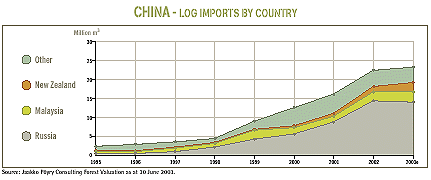
We are confident that there will be further strong growth in the China market.
Domestically, there has been strong demand from sawmills producing framing lumber for the Australasian market and prices have held, but in other key markets there has been a significant fall in NZ dollar prices, particularly during the second six months of the financial year. This fall has been triggered by the combination of a number of factors including lower prices for appearance grade lumber in the US, higher shipping costs and the rapid appreciation of the New Zealand dollar.
OUTLOOK
The outlook for this financial year is uncertain with some economic forecasters predicting stronger world growth but conversely there is no end in sight to the higher NZ dollar.At current log prices, Evergreen is planning to:
- Moderate its harvest level to preserve value in anticipation of log prices improving in the medium term. Based on current market conditions the company expects to reduce its harvest to around 230,000m 3 over the next twelve months.
- Ensure we have the ability to accelerate our harvest again as soon as market conditions improve.
- Target forest areas for harvest that are best suited to the current market. This is currently unpruned stands supplying domestic customers rather than export markets.
- Continue developing profitable niches in export markets, particularly in China and Korea.
- Increase the level of third party log trading to preserve customer relationships and maintain our presence in export and domestic markets.
- Implement ongoing cost control measures.
- Consider selective asset sales.
A reduced harvest will result in a lower cash flow for 2004 and the company is aware that this will delay its ability to provide shareholders with a cash return. However the current market conditions are some of the most challenging that the industry has experienced for many years and the potential value gains from a delayed harvest are considerable. Most commentators believe that we are at or near to the low point in the commodity cycle. Evergreen shares this view.
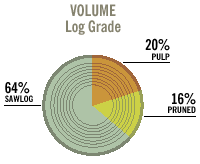
HARVEST PROFILE
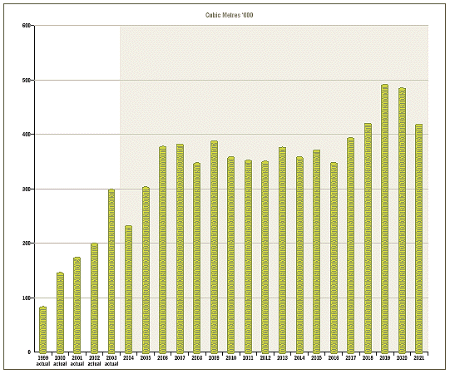
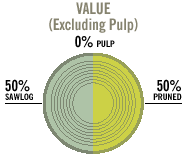
FOREST VALUE: DISTRIBUTION BY LOG TYPE
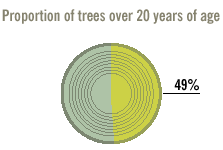
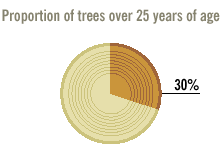
FOREST VALUE DISTRIBUTION BY AGE
These tables are sourced from the Jaakko Poyry Consulting Forest Valuation as at 30 June 2003
EVERGREEN FORESTS NTA
| |
30 June 03 |
30 June 02 |
| Undiluted |
|
|
| Net Asset Value before deferred tax |
$0.70 |
$0.85 |
| Net Asset Value after deferred tax |
$0.60 |
N/A |
| |
|
|
| Fully diluted |
|
|
| (allowing for all convertible instruments converting into shares) |
|
|
| Net Asset Value before deferred tax |
$0.66 |
$0.78 |
| Net Asset Value after deferred tax |
$0.59 |
N/A |
NET ASSET VALUE PER SHARE (UNDILUTED)1 as at 30 June 2003
Value of Evergreenís ordinary shares with different price growth and discount rate assumptions
| |
REAL PRICE INCREASE 2
|
| DISCOUNT RATE3 |
Nil%
|
One%
|
Two%
|
| Eight per cent |
$0.83
|
$0.98
|
$1.14
|
| Nine per cent |
$0.70
|
$0.83
|
$0.97
|
| Ten per cent |
$0.59
|
$0.70
|
$0.82
|
| 1. Before deferred tax. 2. Per annum, over the ten-year period 2008 to 2018. 3. Pre-tax, real. |
FOREST VALUE REDUCTION
The valuation of a long term asset by discounting its projected future cash flows is sensitive to relatively small changes in revenue assumptions. This is particularly evident in Evergreen's 30 June 2003 forest valuation. Jaakko Pöyry Consulting ("JPC "), in completing its annual valuation of the Evergreen estate has lowered its market value assessment from $162.4m as at 30 June 2002 to $141.9m as at 30 June 2003. This valuation change is primarily the result of the lower log prices being used in the valuation. While disappointing, the possibility of a forest value change was foreshadowed in the company's December 2002 interim report to shareholders.
SUMMARY
Forestry as an asset class is a proven inflation hedge, is considered a hard asset, and returns are protected to some degree by physical biological growth of the trees. Investors are increasingly valuing these attributes in the investment environment of the past few years.
In contrast to the steady, reliable growth of the trees is the cyclical nature of the log markets. Flexibility is a key attribute in increasing returns in cyclical markets and the company believes that a combination of lower debt ratios and greater scale that allows full utilisation of administrative capacity are essential goals.
The opportunity to deliver value for shareholders and allow an expectation of a cash yield is dependent on what we as a company do to address the issues of scale and debt ratios and the market prices for New Zealand forest products in the future.
The present challenge is to manage the consequences of a negative pricing period while positioning the company appropriately for the future.
Together with my small and committed team, I am happy to accept that challenge.
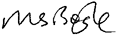
Mark Bogle
CHIEF EXECUTIVE
20 September 2003
Return to Annual Reports
|