 |
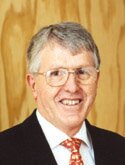
Peter Wilson
CHAIRMAN |
|
| |
|
| |
|
The Directors of Evergreen consider company results for the year to 30th June 2001 to be satisfactory, given the market conditions that have prevailed - particularly in the latter half of this financial year.
Industry expectations for a stable to improving market over the past year were initially borne out with an improvement in log prices. However, the trends reversed quite dramatically in late 2000 and have remained flat over the past 6 months. In that climate, Evergreens profit of $5.044 million combined with an increase in forest value is a good result. Evergreen has positioned itself so as to regulate harvest volumes at times of low prices. We have moderated our harvest relative to potential volumes and as a result we have increased further the future harvest availability of mature stands. This may limit returns through realized profits in the short-term, but is designed to maintain shareholder value, given our expectation of price improvement. The early signs of price improvement in recent months over a number of log grades supports our decision and confirms our belief that harvest flexibility is an important factor in maximising yields from Evergreens forestry investments.
Investments
Over the past year, we have invested $9.4 million (including funding costs) in further development of our existing forests. Much of this investment has been on silviculture to establish pruned stands. This reflects our firm opinion that the greatest returns will be obtained from clear-wood log production and the value added products created from this resource. Our intention is to grow the company, but this objective needs to be tempered. While equity share market values continue to lag below appraised value, further growth that avoids diluting shareholder value is a challenge. However, there are other means for us to capture the benefits of scale and to obtain new income streams and these we continue to actively explore.
Funding
We have recently completed an issue of ordinary shares matched by a pro rata buyback offer to convertible note holders to redeem a portion of their holdings. The buy-back offer was successful which has enabled us to reduce the liability and costs of the accruing interest on the notes, and as a consequence, increase our balance sheet strength. Further initiatives to seek longer term debt structures appropriate to this business are being undertaken.
Industry Outlook
The significance of the US economy to trade has been further amplified this year with forestry sector pricing pressure clearly resulting from the prospective and later evident economic slow down in the US. Recent events in the US may well impact on terms of trade and global supply patterns which could include timber products. For NZ producers, the strong gains in other primary sectors (dairy and meat) have not been realized for forest products. In general, log prices have followed the NZ currency down, rather than benefiting from devaluation through improved NZ dollar prices. That says something about how this industry has positioned itself from a number of perspectives:
- The sector has not been judged as rewarding its shareholders. This is partially market driven but is also related to investor perceptions about unresolved issues in the NZ industry.
- To be effective in a more globally oriented market, our industry must be more coordinated and serve the developing market needs with sustainable supplies of appropriately specified quality products.
- We need to be able to attract investment from offshore to assist us in adding value for NZ and ensure that a fair portion of that value increment remains in this country.
- Our compliance and regulatory needs should be structured to encourage, rather than constrain investment, and that must be possible while maintaining our desire for proper environmental management.
- Infrastructure investment to enable us to get best long-term value from our land-based industries is essential and initiatives now emerging from both industry and government need to be supported. Innovation and new technologies which add value to what we produce in this country should be seen to be a priority for new investment.
The exciting factor for us is that we believe much of what needs to be done can be achieved by the industry, and progress is evident on a number of fronts. There can be no question about the need to succeed given the forestry industry has the capacity to be the principal earner of export revenue, is a prospective major employer, and will sustain many of our rural communities in the future.
The key to these objectives is to be skilled in marketing our products so that there is genuine value based demand and to ensure that our corporate behaviour and returns to investors and shareholders are at a level which engenders support.
Evergreen Outlook
Harvest volumes can increase substantially in the near term. Our policy of acquiring forests with early cash flow options means we can respond to price signals with increased production and look to a sustainable harvest of close to 400,000m3 per annum.
This is where we planned to be at this time and subject to market conditions, the company will increase its harvest activity on an ongoing basis and share the realisation gains with our shareholders.
|
2 0 0 0
|
|
2 0 2 5
|
| $5 billion outputs |
|
$20 billion outputs |
| 4% gdp |
|
14% gdp |
| 22,000 employed |
|
60,000 employed |
| (100,000 indirectly) |
|
(250,000 indirectly) |
| $3.5 billion export earnings |
|
$14 billion export earnings |
| Third largest exporter |
|
Largest exporter |
| Top 20 global suppliers |
|
Top 5 global suppliers |
| 1.7 million hectares |
|
3.5-4 million hectares |
| 17 million m3 harvest |
|
40 million m3 harvest |
$100 million supporting
technologies industry |
|
$1 billion supporting
technologies industry |
We do remain clear in our growth objectives. We have the capability and capacity to grow and manage a much larger forest estate. We will do much of this when the market recognizes the underlying value of our forest assets and has greater confidence in company performance. Evergreen remains confident it can deliver returns by way of yield and share price improvement which will meet investor expectations.
Shareholder Returns
Harvest volumes are set to increase and with that so will the companys cash flows. We are also well advanced with our investments in younger forests and, as promised at last years Annual Meeting of Shareholders, we have reviewed the company policy on shareholder distributions. The company announced on 23 August 2001 that it would not be paying a dividend for the year ended 30 June 2001, but that it would conduct an on market buy back of up to 2,814,687 (2%) of its ordinary shares. The difference between the companys share price and its underlying asset value is considerable and in these circumstances a share buy back represents a good investment for the company while enhancing shareholder value.
Evergreen Directors see returns as being a combination of dividend flows and value increment. Both have capacity for considerable improvement and our efforts remain focused on the delivery of these returns to our shareholders.
Administration
With increasing harvests and cash flows in sight, and with our focus on improving market recognition of the companys intrinsic value, we have at last increased our small administrative resource through the appointment of a treasurer and 2 support staff. The team of 8 will be increased by 2 as a result of Forestry New Zealand becoming a fully owned subsidiary. The Board acknowledges the strong efforts of our executive team during a year of many challenges. We hold the view that our team has the skills, enthusiasm and focus to deliver value to our shareholders.

Peter D. Wilson
CHAIRMAN
20 September 2001
Return to Annual Reports
|