| |
 |
Mark Bogle
CHIEF EXECUTIVE |
|
| |
|
Evergreen has recorded another year of solid operational performance with earnings (before abnormals) increasing by 30% to $6.5m. This is a creditable result considering that market conditions for unpruned sawlogs were disappointing for much of the year.
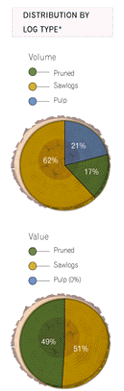
Because of market conditions, the company is harvesting its forests at less than the sustainable level (see harvest profile graph). As a result, we have built up an inventory of mature timber, and as at 30 June 2001, more than half of the appraised value of Evergreens forest estate is represented by trees 20 years or older. This year was one of consolidation as the company continued its transition from its initial development phase to a more production oriented focus. We remain committed to growing the company to capture further economies of scale but not at the expense of shareholder value. The companys low share price has constrained our opportunities for growth through forest acquisition in the past 12 months.
Operations
Evergreen is a pure-play, resource owner with no downstream processing. Its forests are free from long term log supply commitments. This means the company has greater flexibility in terms of the nature and timing of its harvesting activities. A total of 163,039m3 was harvested in the 2001/02 financial year compared with 141,458m3 in the previous year. Production from Rototuna Forest, in Northland, contributed more than three quarters of this total. In addition, the company began harvesting in its South Auckland forests during the year. In order to maximize stumpage value, the company has been trialling the latest in log optimisation technology which involves using electronic callipers to measure logs at harvest. Based on current price information, this technology allows log makers to ensure the best log grades are realised from each tree felled. In addition, exact harvest information is available daily (via the internet) to assist in matching sales to future harvest plans. During the year, Evergreen completed the salvage of approximately 200 hectares of wind damaged, mid rotation forests on the West Coast of the South Island. This area was damaged in a storm in May 2000. All of the companys forests are insured against wind and fire damage of this nature.
Markets
Korea continues to be Evergreens most important export market for logs. There has also been strong domestic demand for high-value pruned logs. Pruned log prices remained firm, principally reflecting increased North American demand for clearwood radiata lumber products from New Zealand. Internationally, prices for unpruned sawlogs recovered off cyclical lows during 2000 but fell again in early 2001. Whilst there has been some improvement in recent months, volatile market conditions have created a difficult environment for log trading and Evergreens marketing subsidiary, Forestry New Zealand, incurred a small deficit for the 12 month period. Evergreen increased its shareholding in Forestry New Zealand during the year and that company is now a wholly owned subsidiary.
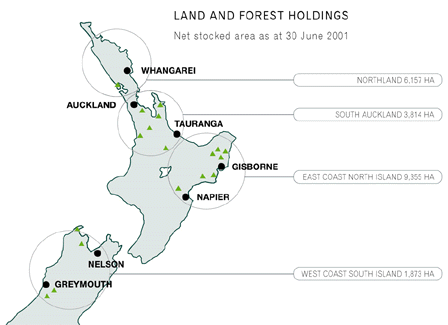
LAND AND FOREST HOLDINGS
Net stocked area as at 30 June 2001
| LAND AND FOREST HOLDINGS |
| AS AT 30 JUNE 2001,IN HECTARES |
LEGAL
AREA
|
PLANTABLE
AREA
|
NET STOCKED
AREA
|
| Owned land |
|
|
|
| Northland |
7,257
|
6,158
|
6,158
|
| South Auckland |
5,577
|
3,927
|
3,814
|
| East Coast |
13,359
|
9,531
|
9,355
|
| South Island |
254
|
208
|
158
|
| Total owned |
26,447
|
19,824
|
19,484
|
| Forestry rights |
|
|
|
| South Island |
2,718
|
2,247
|
1,715
|
| Total all properties |
29,165
|
22,071
|
21,200
|
Valuation
As in previous years, the company engaged Jaakko Pöyry Consulting (Asia-Pacific) Limited (JPC) to independently assess the market value of its forest assets as at 30 June 2001. Net of the area harvested, and incorporating a small ($2.3m) South Island acquisition, Evergreens forest value increased by $8.8 million to $157.4 million over this 12-month period. JPC discounts projected future pre-tax cash flows by 9% real, assuming a recovery to trend-line log prices by 2006 and zero real log price growth thereafter. The net asset value matrix below tests sensitivity across a range of discount rates and real price growth assumptions. Further valuation information is presented on page 10. The latest valuation equates to $0.85 per undiluted ordinary share, or $0.76 a fully diluted basis (after allowing for the notional conversion of the companys 10-year, zero coupon notes).
Nuhaka
Due to the fall in Nuhakas appraised value, Evergreen has written off $1.46 million of its Nuhaka investment. While it is disappointing report this drop in value, it does not have a material impact on Evergreen as Nuhaka represents less than 5% of the companys assets. A significant point of difference between Evergreen and Nuhaka is that Evergreens forest estate is mainly pruned whereas Nuhakas estate is primarily managed on an unpruned framing regime.
| NET ASSET VALUE |
BASED ON APPRAISED MARKET VALUE |
2001
30/6
|
2000
30/6
|
| Book Value of Equity ($m) |
114.4
|
104.4
|
| Add: Forests (at valuation) ($m) |
157.4
|
148.6
|
| Less: Forests (at cost) ($m) |
(151.7)
|
(140.0)
|
| Equity (at valuation) ($m) |
120.1
|
113.0
|
| Divide by: Issued shares (million) |
140.7
|
131.4
|
| Net Asset Value per share ($NZ) |
0.85
|
0.86
|
Fully Diluted Net asset value per share ($NZ)
(assuming all convertible notes convert into shares) |
0.76
|
0.75
|
NET ASSET VALUE (undiluted)
As at 30 June 2001 Value of Evergreenís ordinary shares with different price growth and discount rate assumptions. |
DISCOUNT RATE (2) |
Real price increase(1)
|
|
NIL%
|
ONE%
|
TWO%
|
| Eight per cent |
1.00
|
1.17
|
1.36
|
| Nine per cent |
0.85
|
0.99
|
1.15
|
| Ten per cent |
0.72
|
0.84
|
0.98
|
1. Per annum, over the ten-year period 2006 to 2016.
2. Pre-tax, real. |
Environmental Profile Carbon Sequestration
Increasing importance is being placed on the environmental benefits of plantation forestry as a renewable, sustainable resource. The role plantations play in the absorption of atmospheric carbon and climate control is another positive dimension. Evergreen has 9,600 hectares of forests planted since 1990 that will qualify as carbon sinks under the Kyoto Protocol. A preliminary assessment by JPC is that these Kyoto-compliant forests will sequester up to 2,645 kilo-tonnes of CO2-e over the Protocols first measurement period (2). In this years Annual Report we have included an article by Dr Piers Maclaren, which discusses climate change, forestry, and carbon sequestration (see pages 11-18).
Certification
Evergreens commitment to obtaining certification for its sustainable forestry practices remains in place. Over the past year, the NZ Forest Industry Council has been active in developing national standards for plantation forestry that will link into the Forest Stewardship Council (FSC) certification. FSC is one of the most highly respected certification systems in the world and is supported by the World Wildlife Fund. As these standards are finalised, Evergreen will commence the process to obtain certification.
Wood Processing Strategy Group
Late last year, the government established a Wood Processing Strategy (WPS) Steering Group chaired by the Deputy Prime Minister, with the Forestry Minister as vice-chair. WPS is a partnership involving the forest industry plus both central and local government. Its aim is to significantly accelerate development of the forest products industry in order to obtain optimum value from the regional expansion in wood available for harvest. Several problem areas have been identified and some are already being addressed. For instance, it has been recognised that additional infrastructure (especially road, rail and port facilities) in developing forestry regions such as East Coast and Northland, is a prerequisite for wood processing development and some positive progress has been made. Other key focus areas include the Resource Management Act (RMA), Forest Certification, Trade Access, and Climate Change policy. While the objectives of New Zealands resource management legislation are commendable, some aspects of its implementation are in need of review. Because the process is protracted, inconsistently applied and imposes high costs on the forest industry, it represents a barrier to new investment and regional development. In respect of climate change policy, and the governments commitment to ratification of the Kyoto Protocol, it is important the implementation phase does not prejudice New Zealands international competitiveness. There is a risk that meeting Protocol requirements may put New Zealands wood processing industry at a cost disadvantage relative to developing countries exempted from those requirements.
Summary
The longer-term outlook for sustainably managed plantation forestry remains positive. The past overcutting of tropical rainforests throughout Asia and elsewhere, along with the declining permissible cut in countries such as India and China, will limit future supply from natural forests. Economic development, which will drive per capita consumption, and population growth will inevitably mean
greater demand for wood products. Positive steps are being taken to enhance New Zealands competitive position as a supplier of forest products from its sustainably managed plantations. Evergreen supports these initiatives. Forestry is a sensible component of any well balanced investment portfolio. At present there is an opportunity through Evergreen to invest at a substantial discount to underlying asset value. In addition, by investing in plantation forestry, shareholders are supporting an industry that has already contributed positively to the environment and will continue to do so for generations to come.

Mark S. Bogle
CHIEF EXECUTIVE
20 September 2001
Return to Annual Reports
|
|
|